
3D printing becomes part of everyday creativity. Yet sometimes, completing a 3D printing project can make users feel overwhelming—especially for beginners. One of the challenges is to choose the right filament in 3D printing between easy and real-world performance. With so many filament options on the market, it’s easy to get confused about which material is best for your project. Among them, three materials stand out as the most widely used: PLA, ABS, and PETG.
In this article, we break down the key differences of PLA vs ABS vs PETG filament in a clear and practical way, helping you choose the right filament with confidence and avoid common material-selection mistakes.
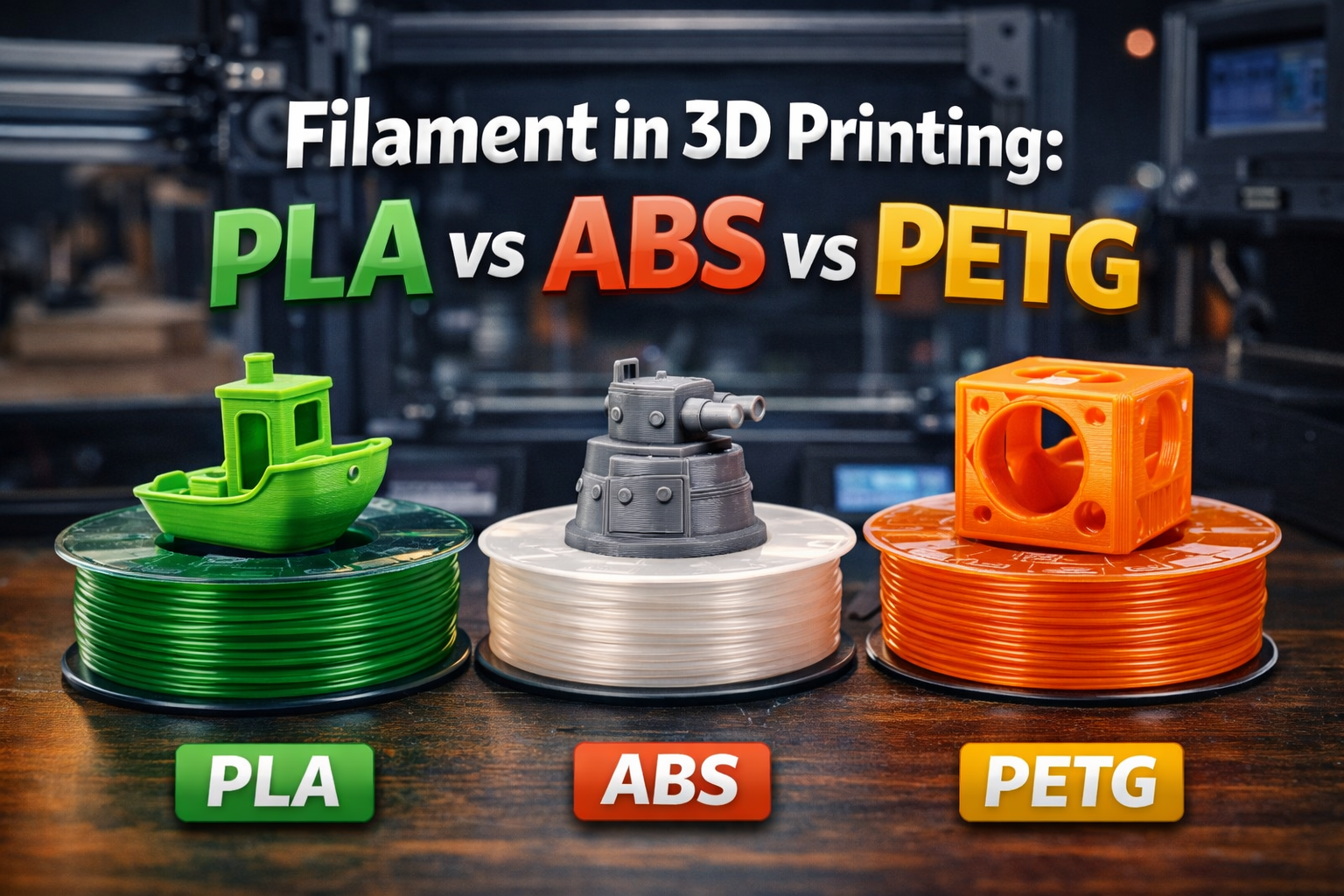
A Quick Overview on PLA vs ABS vs PETG at a Glance
PLA, ABS, and PETG represent three distinct approaches to filament design. Their differences are rooted in material chemistry, printing behavior, and intended use.
Summary of Each Filament’s Core Positioning
Here is a quick summary of 3D printing PLA vs ABS vs PETG materials:
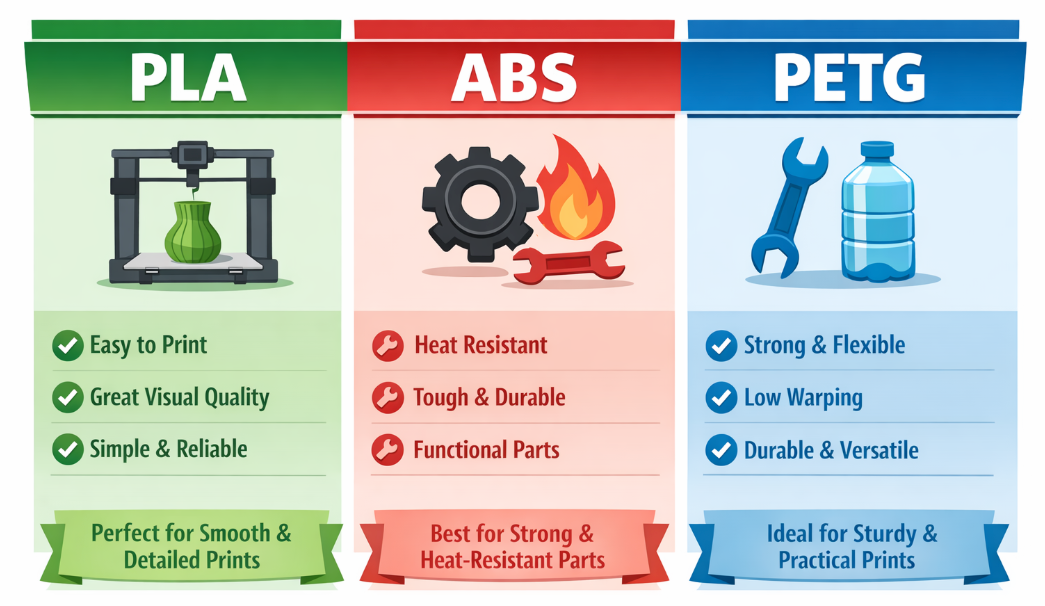
- In PLA 3D printing, the material prioritizes ease of printing, surface quality, and dimensional accuracy
- ABS focuses on durability, heat resistance, and industrial-style performance
PETG balances strength, flexibility, and printing stability
Typical User Profiles for PLA, ABS, and PETG
Here’s how the typical user profile of 3D printing PLA vs ABS vs PETG looks like:
- PLA is typically chosen by users who prioritize simple setup, consistent results, and high-quality visual output rather than mechanical performance.
- ABS users are often producing functional parts that must tolerate heat or mechanical stress
- PETG users typically want stronger parts than PLA without the printing challenges associated with ABS
PLA vs ABS vs PETG: The Material Composition and Basic Characteristics
PLA, ABS, and PETG filaments differ primarily in material composition, which directly affects print behavior, appearance, and real-world performance.
PLA: Plant-Based and Easy to Print
PLA is produced from renewable plant-based sources such as corn or sugar derivatives. Its low melting temperature supports stable extrusion and consistent layer bonding.
PLA delivers smooth surface finishes and high dimensional accuracy, making it well-suited for detailed models and visual prints.
ABS: Petroleum-Based and Industrial-Oriented
ABS is a petroleum-based thermoplastic designed for strength and durability. Its material structure provides good impact resistance and heat tolerance, which is why it is commonly used in industrial and consumer products.
While using ABS, controlled printing conditions are often required due to shrinkage during cooling.
PETG: Modified PET with Balanced Properties
PETG is a glycol-modified PET material that combines strength, flexibility, and chemical resistance. It can produce semi-transparent prints and offers strong layer adhesion.
PETG is positioned between PLA and ABS, providing better durability than PLA while remaining easier to print than ABS. As a result, PETG vs PLA 3D printing is often evaluated when strength and environmental resistance become more important than surface detail alone.
PLA vs ABS vs PETG: Printing Difficulty and User Friendliness
While PLA, ABS, and PETG are all widely used in 3D printing, they don’t behave the same once you start printing. From sensitivity and adhesion, different filaments can quickly shape how enjoyable (or frustrating) a print turns out to be. Understanding these unique challenges is the key to choosing the right filament and getting the results you expect.
PLA: Moisture Sensitivity
PLA is generally easy to print, but it absorbs moisture from the air over time. Moist filament can cause inconsistent extrusion, rough surfaces, and reduced part strength. Proper storage is essential to maintain stable print quality.
PETG: Too Sticky
PETG bonds strongly to build surfaces. While this helps ensure reliable first-layer adhesion, it can make printed parts difficult to remove and may damage the build plate if not handled properly. Using appropriate bed preparation methods or release layers helps control adhesion and prevents removal issues.
ABS: Challenging Airtightness and Cracks
ABS is sensitive to temperature fluctuations during printing. Uneven cooling can lead to cracking and layer separation. Enclosed build environments and stable airflow are often necessary to prevent warping and ensure consistent results.
In PETG vs ABS 3D printing, PETG is often chosen when users want durability without the strict enclosure and airflow requirements of ABS.
The following comparison table examines material type, printing difficulty, strength, heat resistance, and typical applications of 3D printing PLA vs ABS vs PETG materials:
|
Category |
PLA |
ABS |
PETG |
|
Material Type |
PLAnt-based thermoplastic |
Petroleum-based thermoplastic |
Modified PET-based thermoplastic |
|
Printing Difficulty |
Low |
High |
Medium |
|
Printing Temperature |
Low |
High |
Medium |
|
Strength |
Moderate, Rigid |
High, Impact-Resistant |
High, Slightly Flexible |
|
Heat Resistance |
Low |
High |
Medium |
|
Warping Tendency |
Minimal |
High without Enclosure |
Low |
|
Surface finish |
Smooth and detailed |
Often Requires Post-Processing |
Smooth with Slight Gloss |
|
Moisture Sensitivity |
Moderate |
Low |
Low |
PLA vs ABS vs PETG: 3 Common Selection Mistakes
While choosing 3D printing filament between PLA vs PETG vs ABS, it is easy to make avoidable mistakes such as:
-
Assuming “Stronger” Always Means “Better”
Higher mechanical strength does not automatically result in better performance. A rigid or impact-resistant material may perform poorly in applications that require flexibility, surface quality, or dimensional precision. This misunderstanding is especially common in ABS vs PLA 3D printing, where users choose ABS expecting better results without considering application needs.
-
Ignoring Printer Capability and Environment
Not all printers are designed to handle higher temperatures or enclosed printing. Selecting ABS or other demanding materials without proper hardware or environmental control often results in warping, cracking, or failed prints.
-
Overlooking Real Application Conditions
Material selection should account for how the printed part will be used. Exposure to heat, stress, moisture, or outdoor conditions can quickly reveal the limitations of an unsuitable filament choice.
CaiLab’s 3D Printing Filament: Meet Your Diverse Material Demands
At CaiLab, we believe great prints start with great filament. So, we create reliable, easy-to-print materials that help bring your ideas to life—without the frustration. From everyday PLA and PETG to durable ABS and specialty options, our filaments are made to perform smoothly on a wide range of printers.
Each spool is carefully produced for steady extrusion and consistent results, then sealed to stay clean and dry until you’re ready to print. Whether you’re prototyping, learning, or just having fun, CaiLab filaments let you print with confidence and enjoy better results, every time.
Ready to get better results on your print? Buy CaiLab filaments and start printing today!
0 comments