
Warping remains a common challenge when producing large-scale functional parts with silk PLA, especially in batch or factory-style printing. At CaiLab, we often see that bed temperature plays a decisive role in controlling first-layer adhesion and long-term dimensional stability. If the bed temperature is too low, edges may lift during cooling; if it is too high, surface gloss and layer consistency can be affected. Understanding how bed temperature interacts with material behavior is therefore essential for reliable production workflows.
How Bed Temperature Influences Warping Behavior
From a material science perspective, silk PLA bed temperature directly affects how the filament cools and contracts after extrusion. Silk PLA contains modified additives to enhance surface gloss, which also change its thermal response compared to standard PLA. In large functional prints, uneven cooling across a wide footprint can introduce internal stress, leading to warping at corners or thin sections. Through large-scale testing in our own printing farm, we observe that maintaining a stable and moderate heated bed allows layers to cool more evenly, reducing stress accumulation over long print cycles.
Scaling Consistency in Production Environments
When prints move from small experiments to more ambitious personal projects, consistency becomes key. At CaiLab, our guidance and tested material formulations help hobbyists and makers maintain reliable results even on longer prints. Stable bed temperatures ensure that silk-finish parts keep their smooth, glossy appearance without warping or layer issues. This is especially helpful for projects like cosplay props, customized toys, decorative models, or intricate prototypes, allowing creators to enjoy beautiful, professional-looking results with minimal post-processing.
Material Selection and Functional Printing Needs
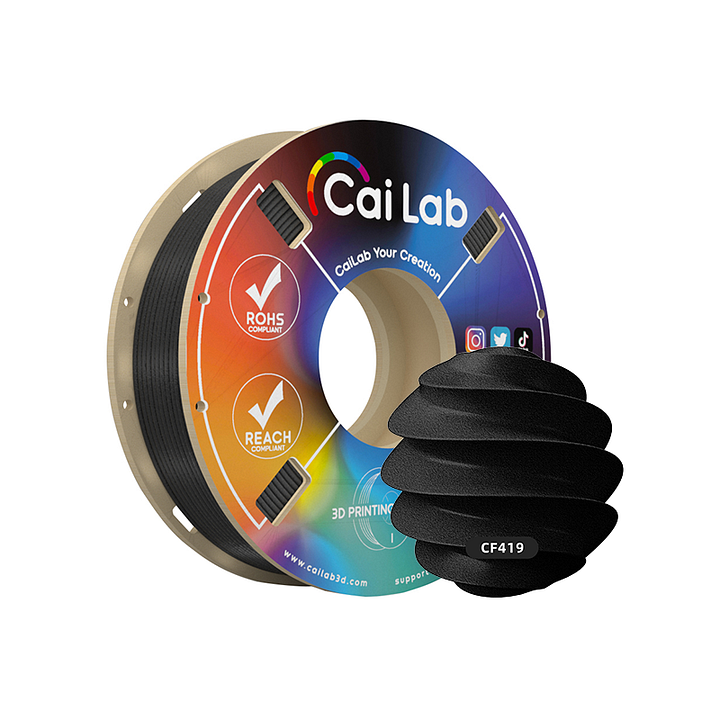
While silk PLA is often chosen for its glossy appearance, some personal projects call for extra strength. For functional prints that need added stiffness or lightweight reinforcement, CaiLab PLA-CF Filament, 1.75mm, 1kg Spool is an excellent choice—perfect for DIY brackets, tool handles, jigs, desktop accessories, or educational robotics projects. Even for hobbyists, maintaining stable bed temperatures ensures dimensional accuracy, while the carbon-fiber reinforcement delivers durable, long-lasting prints. By pairing the right material with proper thermal settings, makers can minimize trial-and-error and enjoy consistent, professional-quality results in home setups or small personal workshops.
Conclusion: Bed Temperature as a Process Variable
In conclusion, selecting an appropriate silk PLA bed temperature is a practical way to prevent warping in large-scale functional prints. Through controlled material sourcing, large-volume testing, and continuous formulation refinement, we focus on helping professional users achieve stable and repeatable results. Whether producing decorative silk-finish components or functional parts using carbon-fiber-reinforced PLA, understanding thermal behavior at the build plate level supports smoother production and more predictable output across different applications.
0 comments