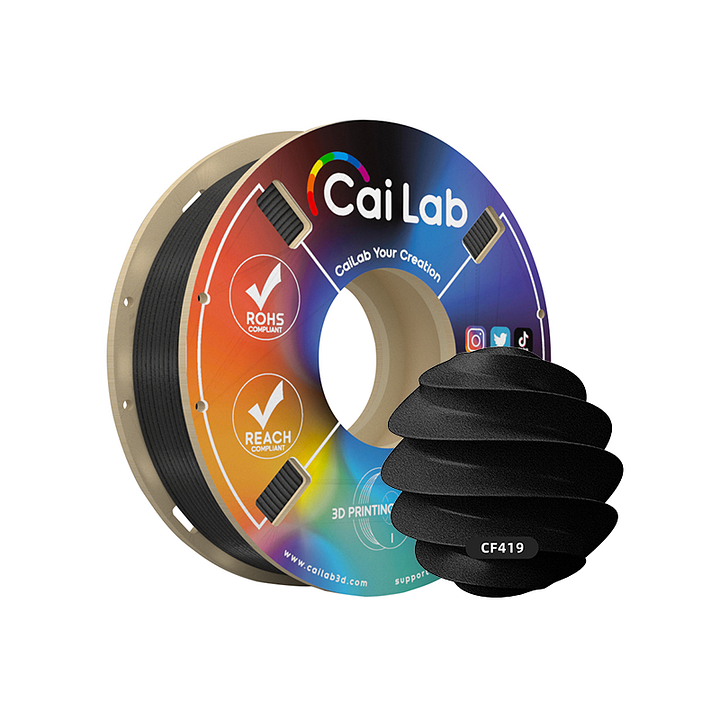
ABS, as a high-performance 3D printing material, stands out for its excellent heat resistance, UV aging resistance, and good water resistance, delivering outstanding comprehensive performance. However, it is prone to warping and emits odors during the printing process. CaiLab ABS effectively mitigates warping and cracking tendencies while retaining excellent impact strength, and features superior flow characteristics that are well-suited for high-speed printing requirements.
Basic information
| Property |
Data |
| Material name |
ABS |
| Density |
1.08g/cm³ |
| Moisture content |
0.46% |
| Test standards |
ISO 527, ISO 178, ISO 180, ISO 75, GB/T 3682, GB/T 37643 |
Tensile · ISO 527
| Property |
Direction |
Data |
Unit |
| Tensile Strength |
Y |
47.741 |
MPa |
| Tensile Strength |
X |
36.632 |
MPa |
| Tensile Strength |
Z |
15.709 |
MPa |
| Breaking Elongation Rate |
Y |
8.149 |
% |
| Breaking Elongation Rate |
X |
6.584 |
% |
| Breaking Elongation Rate |
Z |
4.226 |
% |
Bending · ISO 178
| Property |
Direction |
Data |
Unit |
| Bending Strength |
Y |
71.776 |
MPa |
| Bending Strength |
X |
36.552 |
MPa |
| Bending Strength |
Z |
21.275 |
MPa |
| Bending Modulus |
Y |
2399.237 |
MPa |
| Bending Modulus |
X |
2154.443 |
MPa |
| Bending Modulus |
Z |
1896.131 |
MPa |
Impact · ISO 180
| Property |
Direction |
Data |
Unit |
| Impact Strength |
Y |
7.422 |
kJ/m² |
| Impact Strength |
X |
4.603 |
kJ/m² |
| Impact Strength |
Z |
2.231 |
kJ/m² |
Thermal properties
| Property |
Direction / condition |
Data |
Unit |
| Heat Deflection Temperature |
X Axis |
75.6 |
°C |
| Melt Index |
190℃ / 2.16kg |
8.55 |
g/10min |
Recommended printing parameters
These settings are reference values for a Bambu Lab P1S; adjust for the printer, model and requirements.
| Setting |
Data |
| Nozzle Temperature / Speed |
Temperature ℃ Speed mm/s 230-260℃ <250 mm/s |
| Maximum Volumetric Flow |
16.2 mm³/s |
| Nozzle Diameter |
0.2/0.4/0.6/0.8mm |
| Pre-printing Drying Conditions |
Forced-air oven: 80°C, 8h X1 series printer heated bed: 90–100°C, 12h |
| Print Bed Surface Preparation |
Application of a glue stick or bed adhesive isrecommended prior to printing. |
| 3D Printer Bed Texture |
PEI Plate / Smooth PEI Plate |
| Bed Temperature |
90-95℃ |
| Cooling Fan |
0-80% |
| Retraction Distance |
0.8-1.4mm |
| Retraction Speed |
20-40mm/s |
| Ambient Temperature |
35-45℃ |
| Printing & Storage Conditions |
<20% RH(Avoid direct sunlight, tightly sealed with desiccant) |
Key characteristics
Excellent Impact Toughness ABS exhibits outstanding drop and impact resistance, making printed parts less prone to cracking or brittle fracture under stress. It is well-suited for functional parts that are required to withstand mechanical loads. Good Heat Resistance Heat deflection temperature is approximately 75.6°C, significantly higher than that of standard PLA. Parts can maintain their shape and mechanical properties even in relatively high-temperature environments. Printing Considerations ABS requires a stable ambient temperature during printing (an enclosed chamber is recommended) and a heated bed to prevent delamination and warping. Proper slicing parameters and environmental control are essential for successful printing. Application Positioning ABS addresses the user need for printed parts that combine strength, toughness, and heat resistance, suitable for functional validation or end-use applications. It is one of the most widely used FDM engineering-grade filaments. Annealing Instructions The recommended annealing temperature for ABS is 80–90°C for 6–12 hours. Annealing results depend on factors such as temperature, duration, model size, geometry, and infill settings. Some models may experience deformation or warping after annealing. Annealing and drying must be performed in an oven with uniform temperature distribution and adequate volume (e.g., a forced-air oven). Avoid placing materials near heating elements. Do not use microwave ovens or kitchen ovens, as they may damage the filament, spool, or printed parts. General Notes This product is an engineering-grade 3D printing filament, suitable for functional prototypes, jigs and fixtures, and end-use parts. However, prolonged exposure to UV light or organic solvents is not recommended.
Specimen printing conditions
| Setting |
Data |
| Nozzle Temperature |
260℃ |
| Bed Temperature |
80℃ |
| Wall Layers |
2 layers |
| Top and Bottom Layers |
Top 5 layers / Bottom 3 layers |
| Infill |
100% |
| Ambient Temperature |
23-25℃ |
| Cooling Fan |
On |
| Printing Speed |
45mm/s |
| Nozzle Diameter |
0.4mm |
All specimens were printed on a Bambu Lab P1S. ABS exhibits excellent impact resistance, toughness, and heat resistance (heat deflection temperature approx. 75.6°C), with overall mechanical properties superior to those of conventional PLA. However, annealing treatment should be carefully evaluated based on the specific application scenario: appropriate annealing can enhance heat resistance and relieve internal stresses, but it may also reduce ductility and impact strength. Additionally, the thermal shrinkage during annealing can cause warping, delamination, or dimensional deviations in thin-walled, large flat, or complex structural parts. Therefore, unless there is a clear requirement for improved heat resistance and appropriate process compensation for shrinkage has been implemented, annealing is not recommended for high-precision or complex ABS printed parts. To further optimize the strength, rigidity, or deformation resistance of ABS printed parts, the following approaches are recommended: Increase shell thickness or infill density to enhance the cross-sectional moment of inertia; Optimize structural design by adding ribs, fillets, or chamfers to alleviate stress concentration;
Disclaimer
All typical values stated in this technical data sheet are derived from tests conducted on standard CaiLab specimens and are provided for reference and comparative purposes only. They are not intended to serve as design specifications or quality assurance criteria. Actual performance of 3D printed parts may differ considerably due to factors such as printer types, printing parameters, model geometries, and parameter settings. The fitness of any final printed part depends not only on the filament, but also on factors like part design, operating conditions and printing process. Product specifications are subject to change and may not be separately notified in advance. In the process of using CaiLab 3D Printing Filaments, users are responsible for evaluating the safety, legality, technical performance for their intended applications, as well as waste disposal/recycling methods. CaiLab is not responsible for the use of materials and scenarios, nor for any damage that occurs in the process of using our 3D printing filaments.