
This report presents SVHC screening results for the submitted sample. Refer to the PDF for the tested substances, sample details, test dates, and scope.
Content unavailable.
BBSFLMTDownload ↗
BBSFLMTDownload ↗
BBSFLMTDownload ↗
BBSFLMTDownload ↗
BBSFLMTDownload ↗
BBSFLMTDownload ↗
BBSFLMTDownload ↗
BBSFLMTDownload ↗
BBSFLMTDownload ↗
BBSFLMTDownload ↗
BBSFLMTDownload ↗
BBSFLMTDownload ↗
BBSFLMTDownload ↗
BBSFLMTDownload ↗
BBSFLMTDownload ↗
BBSFLMTDownload ↗
BBSFLMTDownload ↗
BBSFLMTDownload ↗
BBSFLMTDownload ↗
BBSFLMTDownload ↗
BBSFLMTDownload ↗
BBSFLMTDownload ↗
BBSFLMTDownload ↗
BBSFLMTDownload ↗
BBSFLMTDownload ↗
BBSFLMTDownload ↗
BBSFLMTDownload ↗
BBSFLMTDownload ↗
BBSFLMTDownload ↗
BBSFLMTDownload ↗
BBSFLMTDownload ↗
BBSFLMTDownload ↗
BBSFLMTDownload ↗
BBSFLMTDownload ↗
BBSFLMTDownload ↗
BBSFLMTDownload ↗
BBSFLMTDownload ↗
BBSFLMTDownload ↗
BBSFLMTDownload ↗
BBSFLMTDownload ↗
BBSFLMTDownload ↗
BBSFLMTDownload ↗
BBSFLMTDownload ↗
BBSFLMTDownload ↗
BBSFLMTDownload ↗
CREALITY_PRINTERDownload ↗
CREALITY_PRINTERDownload ↗
CREALITY_PRINTERDownload ↗
CREALITY_PRINTERDownload ↗
CREALITY_PRINTERDownload ↗
CREALITY_PRINTERDownload ↗
CREALITY_PRINTERDownload ↗
CREALITY_PRINTERDownload ↗
ORCA_FILAMENTDownload ↗
ORCA_FILAMENTDownload ↗
ORCA_FILAMENTDownload ↗
ORCA_FILAMENTDownload ↗
ORCA_FILAMENTDownload ↗
ORCA_FILAMENTDownload ↗
ORCA_FILAMENTDownload ↗
ORCA_FILAMENTDownload ↗
ORCA_FILAMENTDownload ↗
Report CANEC24006283402_1. Sample: PLA/PETG/ABS.
PDFDownload ↗
Date: 2024-12-18
Report CANEC24006283401_1. Sample: PLA/PETG/ABS.
PDFDownload ↗
Date: 2024-12-18
SDS CANHL25005121701. Product: 3D printing filament PLA.
PDFDownload ↗
Date: 2025-03-17
This report provides results for selected restricted substances in the submitted sample. Refer to the PDF for the tested substances, sample details, test dates, and scope.
A Safety Data Sheet (SDS, also known as an MSDS) provides information about a material’s composition, handling, storage, and safety precautions. The available file covers the PLA product identified in the document. Refer to the PDF for its full details and scope.
Explore CaiLab technical data sheets for PLA, ABS, and PETG filaments. Choose the PDF that matches your exact material and variant for material properties, recommended printing settings, and test conditions.
PLA: PLA+ Bio, PLA Chameleon, PLA Matte, PLA Rainbow, and PLA Silk.
ABS: CaiLab ABS.
PETG: PETG-CF and PETG Metallic.
Refer to each PDF for its reported values and testing details. A technical data sheet is a material reference; safety information and compliance test results are provided separately under SDS/MSDS, REACH, and RoHS.
Download link for Bambu Studio: Bambu Studio | Bambu Lab
Print Parameters Files:download
First, select File in the top left corner, then choose Import.

select Import Configs to import the preset parameter file.

Once imported successfully, you can find it in User presets. After that, just select the parameters that match the filament and proceed with the print.

Warping remains a common challenge when producing large-scale functional parts with silk PLA, especially in batch or factory-style printing. At CaiLab, we often see that bed temperature plays a decisive role in controlling first-layer adhesion and long-term dimensional stability. If the bed temperature is too low, edges may lift during cooling; if it is too high, surface gloss and layer consistency can be affected. Understanding how bed temperature interacts with material behavior is therefore essential for reliable production workflows.
How Bed Temperature Influences Warping Behavior
From a material science perspective, silk PLA bed temperature directly affects how the filament cools and contracts after extrusion. Silk PLA contains modified additives to enhance surface gloss, which also change its thermal response compared to standard PLA. In large functional prints, uneven cooling across a wide footprint can introduce internal stress, leading to warping at corners or thin sections. Through large-scale testing in our own printing farm, we observe that maintaining a stable and moderate heated bed allows layers to cool more evenly, reducing stress accumulation over long print cycles.
Scaling Consistency in Production Environments
When prints move from small experiments to more ambitious personal projects, consistency becomes key. At CaiLab, our guidance and tested material formulations help hobbyists and makers maintain reliable results even on longer prints. Stable bed temperatures ensure that silk-finish parts keep their smooth, glossy appearance without warping or layer issues. This is especially helpful for projects like cosplay props, customized toys, decorative models, or intricate prototypes, allowing creators to enjoy beautiful, professional-looking results with minimal post-processing.
Material Selection and Functional Printing Needs
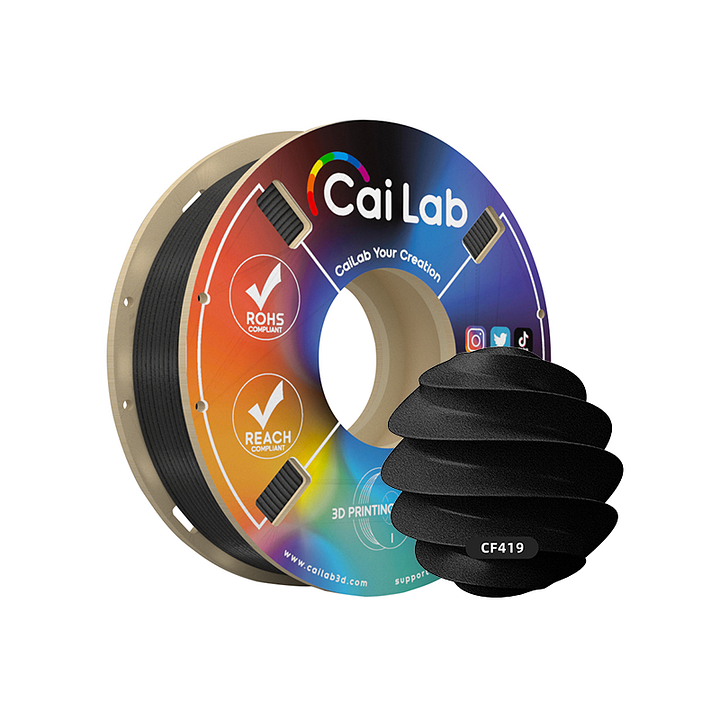
While silk PLA is often chosen for its glossy appearance, some personal projects call for extra strength. For functional prints that need added stiffness or lightweight reinforcement, CaiLab PLA-CF Filament, 1.75mm, 1kg Spool is an excellent choice—perfect for DIY brackets, tool handles, jigs, desktop accessories, or educational robotics projects. Even for hobbyists, maintaining stable bed temperatures ensures dimensional accuracy, while the carbon-fiber reinforcement delivers durable, long-lasting prints. By pairing the right material with proper thermal settings, makers can minimize trial-and-error and enjoy consistent, professional-quality results in home setups or small personal workshops.
Conclusion: Bed Temperature as a Process Variable
In conclusion, selecting an appropriate silk PLA bed temperature is a practical way to prevent warping in large-scale functional prints. Through controlled material sourcing, large-volume testing, and continuous formulation refinement, we focus on helping professional users achieve stable and repeatable results. Whether producing decorative silk-finish components or functional parts using carbon-fiber-reinforced PLA, understanding thermal behavior at the build plate level supports smoother production and more predictable output across different applications.
Selecting the right 3D printing filament is one of the most important decisions you’ll make for your project. The filament you choose affects not only the strength and look of your print, but also the ease of printing and the durability of the final object. Here are the key factors to keep in mind:
1. Material Properties
Different filaments have unique characteristics:
-
PLA – easy to print, eco-friendly, but brittle.
-
ABS – strong and heat-resistant, but requires higher temps and ventilation.
-
PETG – tough, flexible, and moisture-resistant.
-
TPU – elastic and flexible for special applications.
Consider whether you need strength, flexibility, or just a simple beginner-friendly option.
2. Printer Compatibility
Not every filament works with every printer. Check:
-
Nozzle temperature range (some filaments require 250°C+)
-
Bed temperature requirements
-
Enclosure needs (to prevent warping for ABS, Nylon, etc.)
3. Print Environment
Your setup and surroundings matter:
-
Printing in a well-ventilated area? ABS or Nylon might be safe to use.
-
Do you lack a heated bed? Stick with PLA or TPU.
-
Is moisture a concern? Store PETG and Nylon carefully.
4. Surface Finish & Aesthetics
Some filaments give glossy finishes (PLA), while others produce matte, textured, or even metallic looks. If appearance matters (e.g., decorative items, prototypes), factor this into your choice.
5. Cost and Availability
PLA and PETG are affordable and widely available. Specialty filaments (carbon fiber, wood-filled, glow-in-the-dark) are more expensive and may need upgraded hardware.
6. Application Use Case
-
Functional parts → PETG, ABS, Nylon.
-
Prototypes / decorative models → PLA.
-
Flexible wearables or gaskets → TPU.
Conclusion
When choosing a filament, think beyond just what’s “popular.” The material properties, printer setup, environment, look, and end-use all play a role in the best choice for your project. The right filament makes printing easier and ensures your final product performs as expected.
Technical Data Sheet (TDS): ABS.
PDFDownload ↗
Technical Data Sheet (TDS): PETG-CF.
PDFDownload ↗
Technical Data Sheet (TDS): PETG Metallic.
PDFDownload ↗
Technical Data Sheet (TDS): PLA+ Bio.
PDFDownload ↗
Technical Data Sheet (TDS): PLA Chameleon.
PDFDownload ↗
Cover and material description: PLA Matte. Page 2 Material Name reads PLA+ Bio; original PDF retained.
PDFDownload ↗
Technical Data Sheet (TDS): PLA Rainbow.
PDFDownload ↗
Technical Data Sheet (TDS): PLA Silk.
PDFDownload ↗